

Planning
Australian Renovation Cost Guide
Complete guide to renovation costs in Australia, including cost per square metre, budget breakdowns, and tips for getting accurate quotes.
Published on November 20, 2025•15 min read

Complete guide to renovation costs in Australia, including cost per square metre, budget breakdowns, and tips for getting accurate quotes.
Trying to nail down the cost of your renovation in Australia can feel a lot like planning a big trip. Are you backpacking on a shoestring, or are you flying first class all the way? The final bill really depends on your style. A full-home renovation can set you back anywhere from $50,000 to over $300,000, and that number is heavily influenced by how big you want to go, the quality of materials you choose, and even your postcode.
The first question on everyone's lips when they start dreaming about a new kitchen or bathroom is, "How much is this actually going to cost?" It's the bedrock of your entire project, influencing every single decision you make, from the tapware you pick to whether you knock down that wall.
A good way to get a ballpark figure is to think in terms of cost per square metre. It helps you set realistic expectations from the get-go. And it's no secret that renovation costs have been climbing across Australia, thanks to pricier materials and high demand for good tradies.
As a general rule of thumb, you can expect a home renovation in Australia to cost between $2,500 and $4,000 per square metre. But think of this as a starting line, not a finish line. Your taste in finishes and fixtures will ultimately steer the final price. A simple cosmetic refresh will land on the lower end, while a high-end, bespoke project can easily soar past this range.
The chart below gives you a clearer picture of the different cost brackets, depending on the level of quality you're after.
As you can see, a budget-friendly reno might kick off around $2,000 per square metre, but if you have your heart set on premium materials and custom joinery, you could be looking at over $7,000 per square metre.
Let's break down some typical project costs to give you a clearer idea.
| Project Type | Budget Range (AUD) | Mid-Range (AUD) | Luxury Range (AUD) |
|---|---|---|---|
| Kitchen Renovation | $5,000 – $25,000 | $25,000 – $50,000 | $50,000+ |
| Bathroom Renovation | $5,000 – $20,000 | $20,000 – $35,000 | $35,000+ |
| Full House (Interior) | $50,000 – $90,000 | $90,000 – $200,000 | $200,000+ |
| Home Extension (per m²) | $2,000 – $3,000 | $3,000 – $4,500 | $4,500+ |
This table shows just how much the scope and quality can swing the total cost. It's a handy reference to keep in mind as you start mapping out your own project.
Don't forget that where you live plays a huge role in your total spend. The cost of labour and materials simply isn't the same everywhere in Australia.
A renovation in a major hub like Sydney or Melbourne can easily cost 15% to 20% more than the national average. Why? Higher demand for trades and a steeper cost of living. That means the exact same kitchen renovation could have a very different price in Perth than it would in Sydney.
Certain rooms, like kitchens and bathrooms, are always more expensive because they require specialised trades (plumbers, electricians, tilers) and costly materials. A solid mid-range kitchen usually lands between $25,000 and $50,000, while a standard bathroom update can run anywhere from $5,000 to $35,000. These figures really drive home why getting detailed, location-specific quotes is so crucial. You can find more great insights on these cost breakdowns in recent Australian property analyses.

So, where does all the money actually go when you're renovating? It can feel like one big, mysterious number, but every project budget is really just made up of three key parts. Getting your head around these categories is the first step to feeling in control of your spending and making smart choices.
Think of your total reno fund as a pie. The three main slices are Labour, Materials, and all the Professional Fees and permits. Each one is crucial, and knowing how they work together will help you figure out where to save and where it's worth splurging.
This is usually the chunkiest slice of the pie, often chewing up 30% to 50% of your total budget. Labour costs cover the skilled tradies who bring your vision to life - the plumbers, electricians, chippies, tilers, and painters. Let's be honest, their expertise is what makes a renovation safe, sound, and finished beautifully.
Across Australia, these rates can jump around a lot depending on the trade, their experience, and where you live. For example, getting a licensed plumber or electrician out to a job in Perth will likely set you back somewhere between $100 to $150 per hour. A good carpenter will be in a similar ballpark, while painters might charge a little less.
Here's a quick rundown of who does what and why they're essential:
Next up, we have materials. This part of the budget can be a real wildcard, accounting for anywhere from 20% to 40% of the total cost. This is where your personal style really shines, but it's also where your budget can blow out in the blink of an eye. The choices you make here, from tiles to tapware, have the biggest impact on the final look and feel of your space.
Just think about benchtops for a second. A budget-friendly laminate benchtop from Bunnings might cost around $200 per square metre. At the other end of the scale, a stunning natural marble slab could easily soar past $1,500 per square metre. That one decision alone can create a price difference of thousands of dollars in a standard kitchen.
This same logic applies to almost every single item in your reno. From flooring and tapware to light fittings and door handles, there's a massive spectrum of price and quality. The secret to smart budgeting is mixing a few high-impact splurges with savvy savings on the less noticeable items.
For a much deeper dive into building out your financial plan, check out our guide on how to plan a renovation budget. It's packed with tips to make sure you've got all your bases covered.
Finally, don't forget about the "behind-the-scenes" costs, which typically make up 10% to 20% of your renovation total. These are the professional fees and permits that ensure your project is well-designed, structurally sound, and completely legal.
Depending on how big your reno is, you might need to bring in a few different experts:
| Professional | Role in Your Renovation |
|---|---|
| Architect/Designer | They draw up the detailed plans, help you choose materials, and make sure the design works for you and the local council. |
| Structural Engineer | You'll need one of these if you're knocking out walls, adding a storey, or making any changes to your home's structure. |
| Building Certifier | An independent expert who inspects the work at key stages to confirm it meets Australian standards before giving final sign-off. |
On top of these professional services, you'll need to budget for council permits. Simple cosmetic updates probably won't need one, but almost any structural change, extension, or major plumbing work certainly will. These application fees can run from a few hundred to several thousand dollars, depending on your local council and the project's complexity. Factoring these in from day one is the best way to avoid nasty surprises down the track.
Alright, let's talk about the big two. When you're planning a reno, the kitchen and bathroom are almost always the heavyweights, both in terms of the work involved and the chunk they take out of your budget.
These aren't just any rooms. They're high-traffic, highly functional spaces crammed with plumbing, wiring, and expensive fixtures. Think of them as the engine room and the control centre of your home – a lot is going on behind the walls and under the floor. That's why getting the budget right for these two areas is absolutely make-or-break for your entire project.
The kitchen is the heart of the home, right? Well, the cost to renovate it certainly reflects that. In Australia, you could be looking at anything from a $5,000 cosmetic facelift to a full-blown custom job that sails past $50,000. Where your project lands on that scale really boils down to three things: are you moving walls and pipes, what materials are you choosing, and how fancy are the appliances you want?
Let's break it down into a few common brackets.
Don't let their small size fool you; bathrooms punch well above their weight when it comes to renovation costs. Why? Because you're packing a huge number of specialised trades into a tiny footprint. Waterproofing, tiling, intricate plumbing, and electrical work all add up, giving bathrooms a very high price tag per square metre.
Across Australia, the average spend on a bathroom reno in 2025 has hit around $26,747, pushed up by our growing love for things like smart toilets and custom vanities.
Most projects fall into these tiers:
The real cost drivers here are any changes to plumbing, the amount of tiling you do, and the non-negotiable waterproofing. For bathroom renovations specifically, labour costs typically account for 40% to 60% of your total budget, covering plumbers, electricians, tilers, and builders. Plumbers typically charge between $100 and $150 per hour, and you can expect to pay anywhere from $35 to $120 per square metre just for the labour to lay your tiles.
Here's a piece of advice I give every client: the single biggest thing that will blow out a kitchen or bathroom budget is moving the plumbing. Shifting a toilet, a sink, or a shower drain means your plumber has to start cutting into concrete slabs or chasing into walls. It's a huge, labour-intensive job. If you can, keeping your layout is the number one way to keep costs under control.
Bringing your new kitchen or bathroom to life is a team sport. Even if you hire a general builder to run the show, they'll be bringing in a whole crew of specialists to get the job done right.
Here's a quick rundown of who you'll need and a ballpark of what they charge per hour in Australia:
| Trade Professional | Role in Kitchen & Bathroom Renos | Average Hourly Rate (AUD) |
|---|---|---|
| Plumber | Connects all fixtures, moves drainage and water lines. Absolutely essential and legally required. | $100 - $150+ |
| Electrician | Installs all your lighting, power points, switches, and hardwired appliances. | $100 - $140+ |
| Cabinet Maker | Builds and fits all the custom or semi-custom joinery for your kitchen and vanity. | $70 - $120+ |
| Tiler | Lays the floor and wall tiles. It's a finishing trade, so precision is everything. | $60 - $100+ |
| Waterproofer | Applies the crucial waterproof membrane in the bathroom. This must be done by a licensed pro. | $50 - $80+ |
| Painter | Puts the final coats on walls, ceilings, and trim for that polished, finished look. | $50 - $70+ |
These rates are a good starting point, but remember, the total labour cost will always depend on how complex your specific project is. By getting your head around these room-specific costs and the trades you'll need to hire, you're in a much, much better position to set a realistic budget and plan a reno that brings your vision to life without any nasty financial surprises.
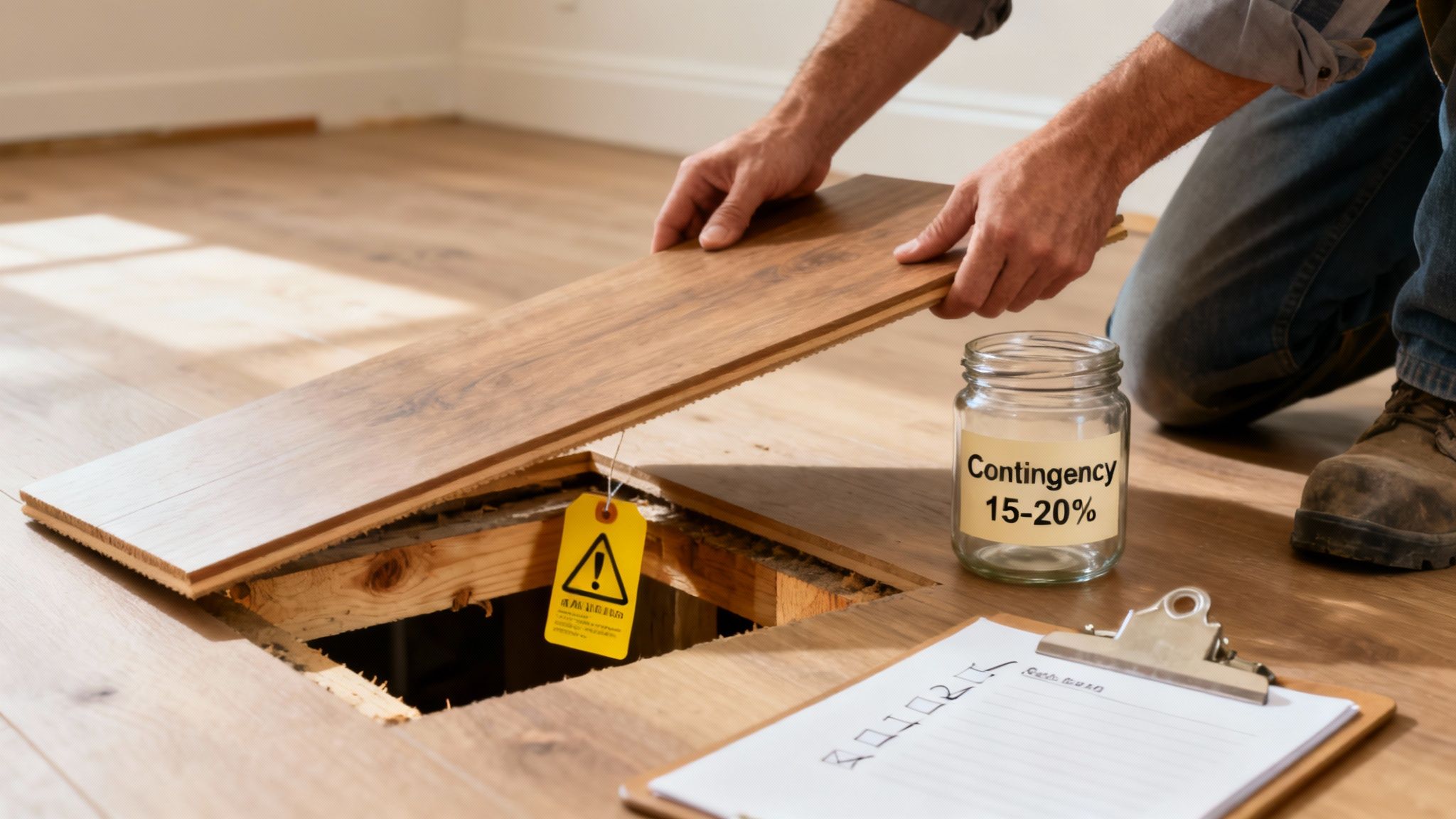
Think of a renovation budget like an iceberg. You see the shiny, exciting bits on the surface - the beautiful tiles, the new appliances, the fresh coat of paint. But the real danger, the part that can sink your project, is often lurking just out of sight. These are the hidden expenses that can completely derail your plans if you're not ready for them.
The moment you start pulling down walls or lifting old floorboards, especially in older Aussie homes, you're stepping into the unknown. It's these unwelcome surprises that can turn a meticulously planned budget upside down.
From our experience, certain unexpected costs pop up far more often than others during Australian renovations. Just knowing what these potential pitfalls are is the first step in protecting your budget from a major blowout. A little foresight now can save you a world of stress (and money) later on.
Here are some of the usual suspects to watch out for:
It's no wonder that budgeting is such a headache for homeowners. In fact, over 60% of Australian renovators blow their budgets by 20–30%, often because they underestimated these kinds of structural repairs and permit issues. You can dive deeper into these figures by checking out the full home renovation statistics for Australia.
This is exactly why a contingency fund is your renovation's best friend. It's not just a 'nice-to-have', it's an absolutely non-negotiable part of any responsible budget. Think of it as your project's insurance policy against the unknown.
This fund is a separate pool of cash set aside specifically for unforeseen problems. It's not for upgrading your tapware halfway through or deciding you want that fancier stone benchtop. It's purely for tackling the problems you couldn't have possibly predicted.
A solid rule of thumb is to set aside 15% to 20% of your total estimated renovation cost for your contingency fund. For older homes where the risk of finding nasties like asbestos is higher, you should definitely lean towards the 20% mark.
So, on a $100,000 renovation, this means having an extra $15,000 to $20,000 ready and waiting. It might feel like a lot to add on top, but that financial buffer is what ensures a surprise discovery doesn't force you to cut corners or, worse, stop the project in its tracks. It's the key difference between a stressful, budget-blowing nightmare and a smooth, successful renovation.
Alright, let's talk about the moment of truth: moving from a rough ballpark figure to a firm, written quote. This is where you gain real control over your renovation costs. Getting a quote isn't just about shopping for the cheapest price; it's about finding a builder who truly gets your vision and has the skills to bring it to life without blowing your budget.
The secret? You need to make sure every single builder is quoting on the exact same job.
To do that, you have to become the director of your own project. Before you even think about picking up the phone, you need a detailed project brief. This document is your renovation bible. It's what ensures you can compare quotes apples-for-apples, instead of trying to make sense of a bunch of vague, confusing proposals.
Think of your project brief as the script for your reno. The more detail you pack in now, the more accurate the quotes will be - and the fewer nasty surprises you'll have to deal with later. A vague brief always leads to vague quotes, which is a recipe for budget blowouts.
Your brief needs to be airtight. It should include:
This level of detail forces every builder to price the exact same items and removes all the guesswork. Without it, one builder might quote for a cheap laminate benchtop while another prices for high-end marble, making their final numbers impossible to compare fairly.
Once the quotes start rolling in, it's time to put on your detective hat. Don't just skip to the final number at the bottom. A surprisingly cheap quote is often a massive red flag, signalling that things have been missed or the builder has used low-quality allowances to get the price down.
Here's what to look for in every quote:
A quote that seems too good to be true probably is. Vague descriptions like "install new kitchen" or "make good walls" are where things go wrong. This ambiguity is the builder's wiggle room, and every unspecified detail becomes a "variation" that you have to pay extra for later.
Finally, before you sign on the dotted line, do your homework. Choosing the right builder is the single best way to save money and stress in the long run.
Taking these steps turns the quoting process from a stressful gamble into a structured, informed decision. It's how you lock in a fair price and find a pro you can actually trust to build your dream space.
When you're staring down the barrel of a renovation, a million questions can start swirling around. It's completely normal. To help you feel more confident as you plan, we've put together some clear, straightforward answers to the questions we hear most from Australian homeowners.
Think of this as your quick-reference guide. It's designed to tackle those specific worries and give you the practical insights you need to make smarter financial decisions from day one.
A contingency fund is your project's financial safety net, and honestly, it's non-negotiable. This is the money you stash away purely for the unexpected problems that can, and often do, pop up once the work gets started.
For most Aussie renos, a good rule of thumb is to set aside 15% to 20% of your total estimated project cost. The age of your home is a massive factor here. If you're tackling an older character home where hidden issues like asbestos, dodgy wiring, or termite damage are a real possibility, you should absolutely aim for that 20% mark. It might feel like a lot, but the peace of mind is priceless.
On the other hand, for newer properties or purely cosmetic updates, like a quick paint job or replacing benchtops without moving any plumbing, you might get away with a 10% to 15% fund.
Remember, this fund is strictly for unforeseen expenses. It's not a slush fund to upgrade your tapware or splurge on a fancier oven halfway through. It's the single most important tool for stopping a budget blowout in its tracks and keeping your stress levels manageable.
This is the big one for anyone with a home that needs a lot of work. The short answer? It completely depends on the state of your house and the scale of your vision.
Renovating is almost always the more cost-effective path if your home is structurally sound. If the "bones" of the house, the foundation, frame, and roof, are in good nick, then working with what you have will save you a huge amount of money. A renovation lets you keep the character you love while bringing the home into the 21st century.
However, the scales can tip if the changes you want are massive. If your reno involves serious structural work (like knocking out multiple load-bearing walls), fixing major foundation issues, and a complete gut-and-replace of all the plumbing and electrical, the costs can start to creep up. Sometimes, they can even surpass the price of a knockdown-rebuild.
A knockdown-rebuild gives you a completely clean slate. You get a brand-new home built to modern energy and safety standards, with zero hidden nasties. The best approach is to get a professional building inspection first, then get detailed quotes for both scenarios. That's the only way to make a truly informed decision based on hard numbers.
Even the most meticulously planned budgets can go off the rails. Knowing the common culprits is the first step to avoiding them.
In our experience, budget blowouts in Australian renovations almost always boil down to a handful of key issues. Keep these on your radar, and you'll have a much better chance of staying on track.
Saving a bit of cash doesn't have to mean settling for a cheap-looking result. There are plenty of smart ways to trim your renovation costs while still achieving a high-quality finish.
First off, consider doing some of the non-structural work yourself. If you're handy with a paintbrush or don't mind a bit of demolition, handling your own painting or stripping out old cabinetry can save you thousands in labour.
Second, be strategic with your timing. If your project isn't urgent, think about scheduling it for the off-season (usually the winter months). Tradies can be less busy then and might be more flexible on their pricing.
Third, become a savvy shopper. Keep an eye out for end-of-financial-year sales on materials, appliances, and fixtures. You can often find top-quality items at a serious discount if you're patient and willing to hunt around.
Finally, the single most effective way to save money is to work with your home's existing footprint. Moving plumbing, electrical wiring, and gas lines is one of the most expensive parts of any reno. Keeping your kitchen and bathroom layouts where they are will dramatically cut your overall spend.
Planning your renovation just got easier. With Reno Page, you can get a free, instant estimate to understand your potential renovation cost, then connect with trusted, verified tradies in Perth for accurate quotes. Compare profiles, chat securely in the app, and manage your entire project from one place.
Take control of your renovation budget with Reno Page today!
Get expert recommendations and connect with qualified tradies in your area.
Get Started Today